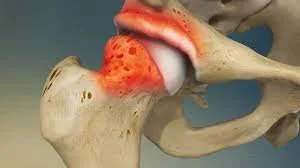
Hip impingement got you in a pinch?
Hip impingement, is often used as a general term to describe hip pain or sensitivity to hip flexion (knee to chest) and internal rotation. The medical diagnosis associated with this is known as Femoral Acetabular Impingement or FAI. The hip joint is a ball-and-socket joint similar to our shoulder joint. The “ball” is the head of the femur (largest bone in the body) or our thigh bone. The “cup or socket” is the acetabulum. The acetabulum is part of our pelvic bone or os coxae.
The rim of the acetabulum is much deeper than that of the shoulder, providing more stability than the shoulder. The labrum of the hip attaches to the acetabulum forming a gasket like seal. The acetabulum itself is lined with cartilage proving a smooth joint surface for the femoral head.
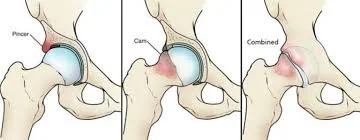
Impingement syndrome, just as it sounds, is a mechanical compression of the ball-and-socket hip joint. Though, impingement syndrome can be made as a clinical diagnosis through history and physical exam, there are different variations. Through imaging, it can be further classified as a cam lesion, pincer, or combined.
A cam lesion or deformity is an abnormal femoral head that is not quite as round as it should be, which can result in “bone spur” AKA osteophyte formation and can lead to breakdown or degeneration of the acetabular cartilage. A pincer lesion is the result of a larger than normal socket. This can result in degradation of the labrum and cartilage. Combined, just as it sounds is a combination of both an abnormal femoral head and an abnormal socket.
So FAI is a mechanical and structural issue, so does it require surgery? While surgery, may be a “quick-fix” surgery is often not needed! Yes, surgery, does provide superior short-term outcomes compared to conservative care. However, conservative care, should be the first-line approach, and MOST suffering from FAI see meaningful clinical improvement WITHOUR SURGERY!
Conservative care will often include supervised PT or rehab, focusing on active strengthening and core stabilization. According to an article in The American Journal of Sports Medicine, the majority (70-82%) of patients, can be managed successfully with conservative treatment alone.
So FAI is a mechanical and structural issue, so does it require surgery? While surgery, may be a “quick-fix” surgery is often not needed! Yes, surgery, does provide superior short-term outcomes compared to conservative care. However, conservative care, should be the first-line approach, and MOST suffering from FAI see meaningful clinical improvement WITHOUR SURGERY!
Conservative care will often include supervised PT or rehab, focusing on active strengthening and core stabilization. According to an article in The American Journal of Sports Medicine, the majority (70-82%) of patients, can be managed successfully with conservative treatment alone.
So what can we do to avoid surgery and concur our hip impingement? FAI rehabilitation focuses on reducing pain, improving joint mobility, and strengthening the glutes, core, and hip muscles to stabilize the joint. No, exercises and stretches won’t change the shape of your hip and eliminate the impingement itself, but it will give you a solid foundation, and can still allow you to become pain free, even with the impingement being present.
Again, we need to work on our glutes, core and surrounding hip muscles. If you’ve already checked out some of our other blogs, some of these exercises will be familiar to you, as they can be great exercises for our core and glutes which are often a focal point of most rehab programs.
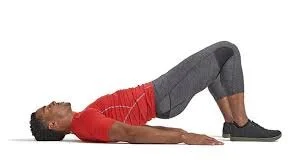
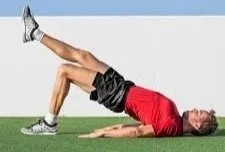
Glute bridge, good for both the core and the glutes! I prefer digging heels in the floor to activate more of the glutes and less of the hamstrings! Also, be sure to abdominal brace to get greater core activation. Start double leg, progressing to single-leg and or add weight!
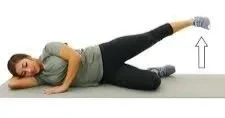
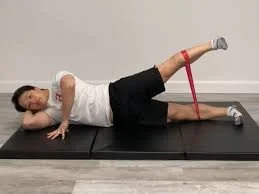
2. Side lying hip ABduction, is a good exercise for strengthening the gluteus medius. This exercise can help with overall pelvic stability. In addition to helping with FAI, this exercise can also help with knee pain and low back pain! You can progress by adding bands!
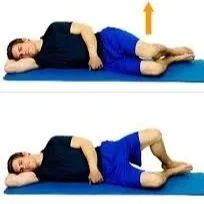
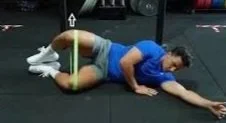
3. Clamshells, is another good exercise that strengthens the gluteus medius as well as the hip external rotators. Again, this exercise will add to overall pelvic stability, to advance, add in resistance bands, may also engage the core by adding in a side plank and doing the clamshell in a side plank position.
4. Pigeon stretch, is a great stretch or yoga pose that is designed to open up your hips and stretches many of the muscles surrounding the hips. It will open your hips while stretching the glutes and piriformis muscle. It alleviates pressure and pain by improving external hip rotation.
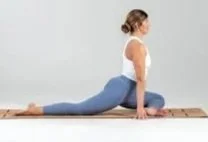
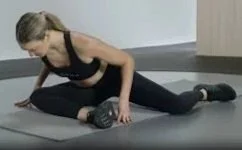
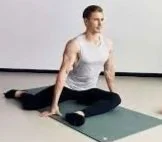
5. 90/90 hip stretch, is another great stretch for overall hip mobility, that’s because its targeting both hips at the same time. You should alternate front leg and back leg, and there are many great variations to this stretch! This stretch again, is going to stretch the hip muscles and glutes, but is also works on the joint capsule itself. In this 90/90 position the front leg is working on external rotation, while the bag leg is targeting internal rotation.
We hope that these exercises and stretches can help get you out of a pinch! Cole Spine and Performance is here to provide evaluation and management of your musculoskeletal conditions!
We look forward to seeing you at Cole Spine and Performance, to help get you pain free and optimize your performance!